

If you’re searching for practical insights into design for manufacturability hardware, you’re likely trying to bridge the gap between an exciting device concept and a product that can actually be built at scale. Too many promising hardware ideas fail—not because they lack innovation, but because they overlook the manufacturing realities that determine cost, reliability, and time to market.
This article is built to help you avoid those pitfalls. We break down the core principles that make hardware designs production-ready, from material selection and tolerance planning to assembly optimization and supply chain alignment. Whether you’re developing a prototype or preparing for mass production, you’ll gain clear, actionable guidance tailored to real-world engineering constraints.
Our insights are grounded in hands-on hardware development experience, industry best practices, and ongoing analysis of emerging manufacturing technologies. The goal is simple: help you design smarter today so your hardware can be built efficiently tomorrow.
Brilliant prototypes often crumble under factory lights. I have seen teams celebrate a flawless CAD render, only to stall when tolerances clash and suppliers push back. That is why I believe manufacturability is not a phase, but a mindset. In other words, design for manufacturability hardware decisions belong on day one. Define Design for Manufacturability, or DFM, as building products that factories can reliably repeat at scale. For example, simplifying fastener types trims assembly time and errors. Critics argue constraints kill creativity. I disagree; smart limits spark better engineering. Ultimately, bridging prototype and production saves capital, sanity, and reputation long-term.
What is Design for Manufacturability (DFM)? The Blueprint for Success
Design for Manufacturability (DFM) is the practice of creating products that are intentionally easy, efficient, and cost-effective to produce. It is not a last-minute checklist before mass production; it is a concurrent engineering philosophy, meaning design and manufacturing decisions happen together, not in silos. When teams apply design for manufacturability hardware principles early, they reduce friction long before the first factory run.
Why does this matter? Because the benefits compound:
- Lower production costs through fewer parts, simplified geometries, and reduced material waste
- Shorter assembly times that cut labor expenses
- Fewer defects due to standardized, process-friendly features
According to a study by the Design for Excellence program at Boothroyd Dewhurst, up to 70% of a product’s manufacturing cost is determined during the design phase. That means early decisions lock in most future expenses. Companies that invest in DFM routinely report 20–50% reductions in assembly time after redesigns.
There’s a counterargument: focusing heavily on manufacturability can limit creativity. But evidence shows constraints often drive smarter innovation (think of how aerospace weight limits fuel breakthroughs). A design that scales from 10 units to 10,000 without rework is not restrictive—it’s resilient.
Core DFM Principles for Efficient Hardware Design
By adopting best practices in design for manufacturability, hardware engineers can streamline production processes and enhance product quality, much like the innovative approaches highlighted in our article on the Latest Tech Scookietech.
Design for manufacturability hardware is the discipline of shaping a product so it’s easy, repeatable, and cost-effective to build at scale. In practice, that often means choosing simplicity over cleverness (even when the clever option looks cooler in CAD).
1. Part Standardization
Option A: custom screws, niche connectors, unique materials.
Option B: off-the-shelf components like M3 screws and widely available connectors.
While custom parts may promise optimization, standardized components reduce supply chain risk, shorten lead times, and lower cost through economies of scale (McKinsey & Company, 2023). In other words, boring can be beautiful.
2. Minimize Part Count
Separate brackets and covers increase assembly steps and failure points. By contrast, integrating multiple functions into one manufacturable part reduces labor and inventory overhead. Fewer parts mean fewer things to break—like swapping a five-piece hinge for a single molded assembly.
3. Design for Ease of Assembly
Consider symmetrical vs asymmetrical features. Symmetry can cause orientation mistakes; asymmetry prevents them. Tabs, interlocks, and clear tool access speed assembly and reduce human error. (Think IKEA, but with fewer existential crises.)
4. Smart Tolerance and Dimensioning
Tight tolerances—acceptable dimensional variation limits—raise machining costs exponentially (SME, 2022). Focus precision only where parts interface critically; relax it elsewhere.
5. Leverage Process Strengths
Injection molding favors draft angles; casting prefers uniform wall thickness. Designing against process physics invites defects. Pro tip: consult manufacturers before finalizing CAD to avoid costly redesigns.
Strategic Material and Process Selection
Early design decisions lock in up to 70–80% of total product cost (McKinsey & Company). That means your concept-phase material and manufacturing choices matter more than late-stage optimizations. Think of it like casting a movie: pick the wrong lead early, and no amount of editing fixes it.
A Simple Volume Decision Matrix
| Production Volume | Recommended Processes | Cost Profile |
|---|---|---|
| 1–100 units | FDM, SLA, CNC Machining |
High per-part, no tooling |
| 100–5,000 units | Urethane Casting, Sheet Metal | Moderate per-part, low–mid tooling |
| 5,000+ units | Injection Molding, Die Casting | Low per-part, high tooling |
Practical tip: If demand is uncertain, start with CNC or urethane casting before committing to injection molds (which can exceed $20,000 in tooling).
Balancing Function, Cost, and Supply
Material selection isn’t just about tensile strength or heat resistance. A polymer may meet specs but fail in injection molding due to shrinkage or flow limits. Likewise, aluminum shortages can disrupt timelines (as seen during 2021–2022 global supply chain constraints, U.S. Commerce Dept.).
Step-by-step:
- Define functional requirements.
- Match materials to compatible processes.
- Validate supplier availability.
- Recalculate per-unit economics at scale.
This is where design for manufacturability hardware thinking pays off. Before finalizing electronics, revisit understanding high performance pcb design principles: https://fntkdevices.com/understanding-high-performance-pcb-design-principles/. Small layout tweaks now prevent expensive redesigns later (and yes, that’s a painful lesson many teams learn the hard way).
Optimizing for Assembly, Testing, and Service
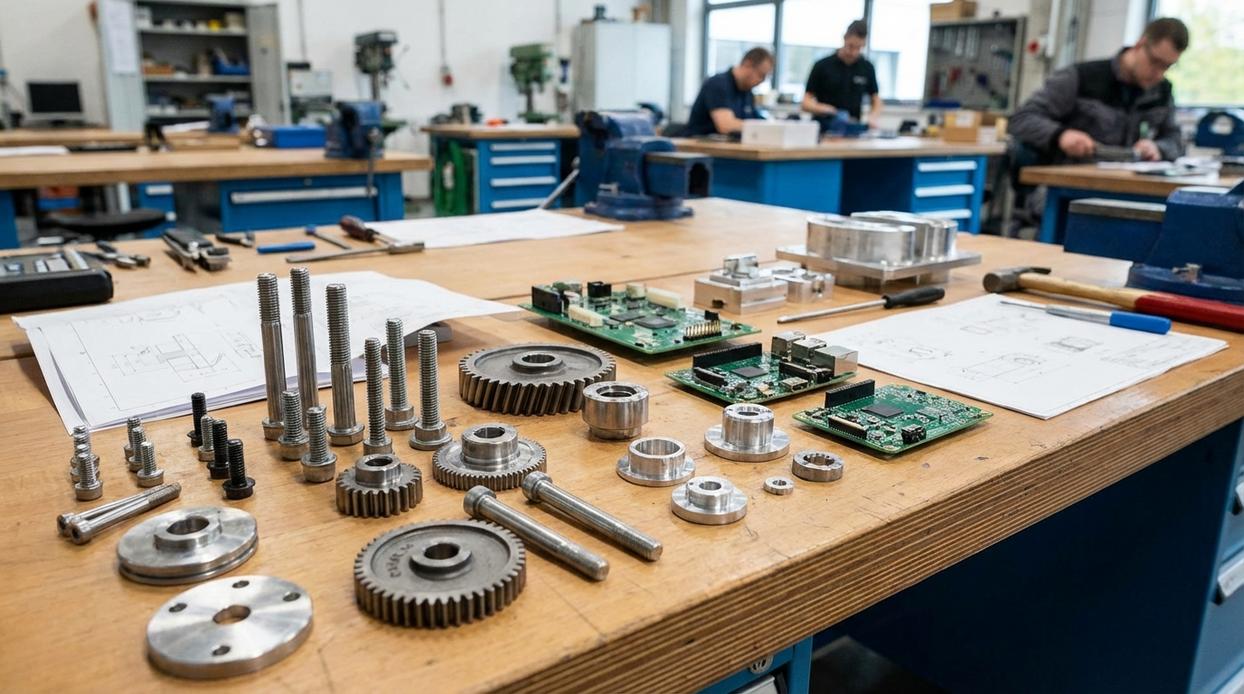
Too many teams obsess over the individual part and forget the bigger picture: how everything actually comes together. In my opinion, that’s backwards. A brilliant component that slows the line is NOT brilliant.
Designing for assembly lines means committing to a single, linear assembly direction whenever possible. If operators have to constantly flip or rotate a device, you’re adding friction (and cost) with every touch. Henry Ford figured this out in 1913 with the moving assembly line—flow matters (Ford Motor Company archives).
I’m also a big believer in obvious test access. Critical electronic test points should be easy to reach without partial disassembly. If a technician needs to “surgically” crack open an enclosure, you’ve already failed.
Then there’s Poka-Yoke—mistake-proofing. Offset mounting holes, keyed connectors, asymmetrical tabs. Make incorrect assembly physically impossible. That’s smart design for manufacturability hardware.
Pro tip: if a part can be installed two ways, someone WILL install it the wrong way.
Building Smarter: Your Next Steps for Efficient Production
Now that you’ve mapped out a smarter path, it’s time to pressure-test it on the floor. In places like Shenzhen’s Huaqiangbei markets or a Midwest contract manufacturing shop, small BOM tweaks can mean weeks saved. Design for manufacturability hardware isn’t theory—it’s what keeps your CM from flagging last-minute ECOs (engineering change orders).
After all, treating manufacturing as a constraint upfront prevents margin-killing respins and stalled SMT lines. So, start here:
- Review your BOM and standardize one custom fastener or simplify one assembly step.
In other words, build it like it’s already headed to the line.
Build Smarter Hardware That Actually Ships
You came here to understand how to move from innovative concept to production-ready device without costly delays, redesigns, or manufacturing surprises. Now you have a clearer path forward.
The biggest pain point in hardware development isn’t creativity — it’s execution. Brilliant ideas fail when they ignore design for manufacturability hardware principles early on. Missed tolerances, fragile components, and unrealistic assembly processes can stall launches and drain budgets fast.
The solution is simple but powerful: integrate manufacturing thinking into every stage of development. Validate materials early. Collaborate with production partners. Prototype with real-world constraints in mind. Test, iterate, refine — before scaling.
If you’re serious about turning device concepts into scalable, production-ready products, don’t wait for manufacturing problems to surface. Learn from proven hardware engineering insights and emerging interface innovations trusted by thousands of forward-thinking builders.
Start applying smarter development principles today — and build hardware that doesn’t just look good on paper, but ships successfully.
 Hazel Brinkleyanday has opinions about advanced concepts. Informed ones, backed by real experience — but opinions nonetheless, and they doesn't try to disguise them as neutral observation. They thinks a lot of what gets written about Advanced Concepts, Tech Innovation Updates, FNTK Hardware Engineering Insights is either too cautious to be useful or too confident to be credible, and they's work tends to sit deliberately in the space between those two failure modes.
Reading Hazel's pieces, you get the sense of someone who has thought about this stuff seriously and arrived at actual conclusions — not just collected a range of perspectives and declined to pick one. That can be uncomfortable when they lands on something you disagree with. It's also why the writing is worth engaging with. Hazel isn't interested in telling people what they want to hear. They is interested in telling them what they actually thinks, with enough reasoning behind it that you can push back if you want to. That kind of intellectual honesty is rarer than it should be.
What Hazel is best at is the moment when a familiar topic reveals something unexpected — when the conventional wisdom turns out to be slightly off, or when a small shift in framing changes everything. They finds those moments consistently, which is why they's work tends to generate real discussion rather than just passive agreement.
Hazel Brinkleyanday has opinions about advanced concepts. Informed ones, backed by real experience — but opinions nonetheless, and they doesn't try to disguise them as neutral observation. They thinks a lot of what gets written about Advanced Concepts, Tech Innovation Updates, FNTK Hardware Engineering Insights is either too cautious to be useful or too confident to be credible, and they's work tends to sit deliberately in the space between those two failure modes.
Reading Hazel's pieces, you get the sense of someone who has thought about this stuff seriously and arrived at actual conclusions — not just collected a range of perspectives and declined to pick one. That can be uncomfortable when they lands on something you disagree with. It's also why the writing is worth engaging with. Hazel isn't interested in telling people what they want to hear. They is interested in telling them what they actually thinks, with enough reasoning behind it that you can push back if you want to. That kind of intellectual honesty is rarer than it should be.
What Hazel is best at is the moment when a familiar topic reveals something unexpected — when the conventional wisdom turns out to be slightly off, or when a small shift in framing changes everything. They finds those moments consistently, which is why they's work tends to generate real discussion rather than just passive agreement.